Incoterms Explained: FOB vs EXW, DAP vs DDP for K-Beauty Wholesale Buyers
Published: 2026.02.11
Last updated: 2026.10.26
When importing cosmetics from Korea, most issues don’t come from the products themselves.
They usually come from unclear responsibility across shipping, customs steps, and risk transfer.
Many buyers search:
What is the difference between DAP and DDP?
FOB vs EXW — what’s the real cost difference?
What do Incoterms DAP and Incoterms DDP mean?
What Are Incoterms?
Incoterms (International Commercial Terms) are international trade rules published by the International Chamber of Commerce (ICC).
They clarify:
Who pays which logistics costs
Who manages customs steps
When shipping risk transfers
Who is responsible if loss or damage occurs
At SEOUL4PM, the most commonly used terms are:
EXW (Ex Works)
FOB (Free On Board)
DAP (Delivered At Place)
DDP (Delivered Duty Paid)
How SEOUL4PM Uses Incoterms
Your shipping setup determines the applicable Incoterm.
If you use your own forwarder:
→ EXW or FOB
If shipping is arranged through SEOUL4PM:
→ DAP or DDP
This structure keeps responsibilities aligned with who controls each step of the shipment.
FOB vs EXW: Cost and Risk Differences
Many buyers ask: FOB vs EXW — which is better?
In practice, the answer depends on logistics capability and where you prefer the handoff point to be.
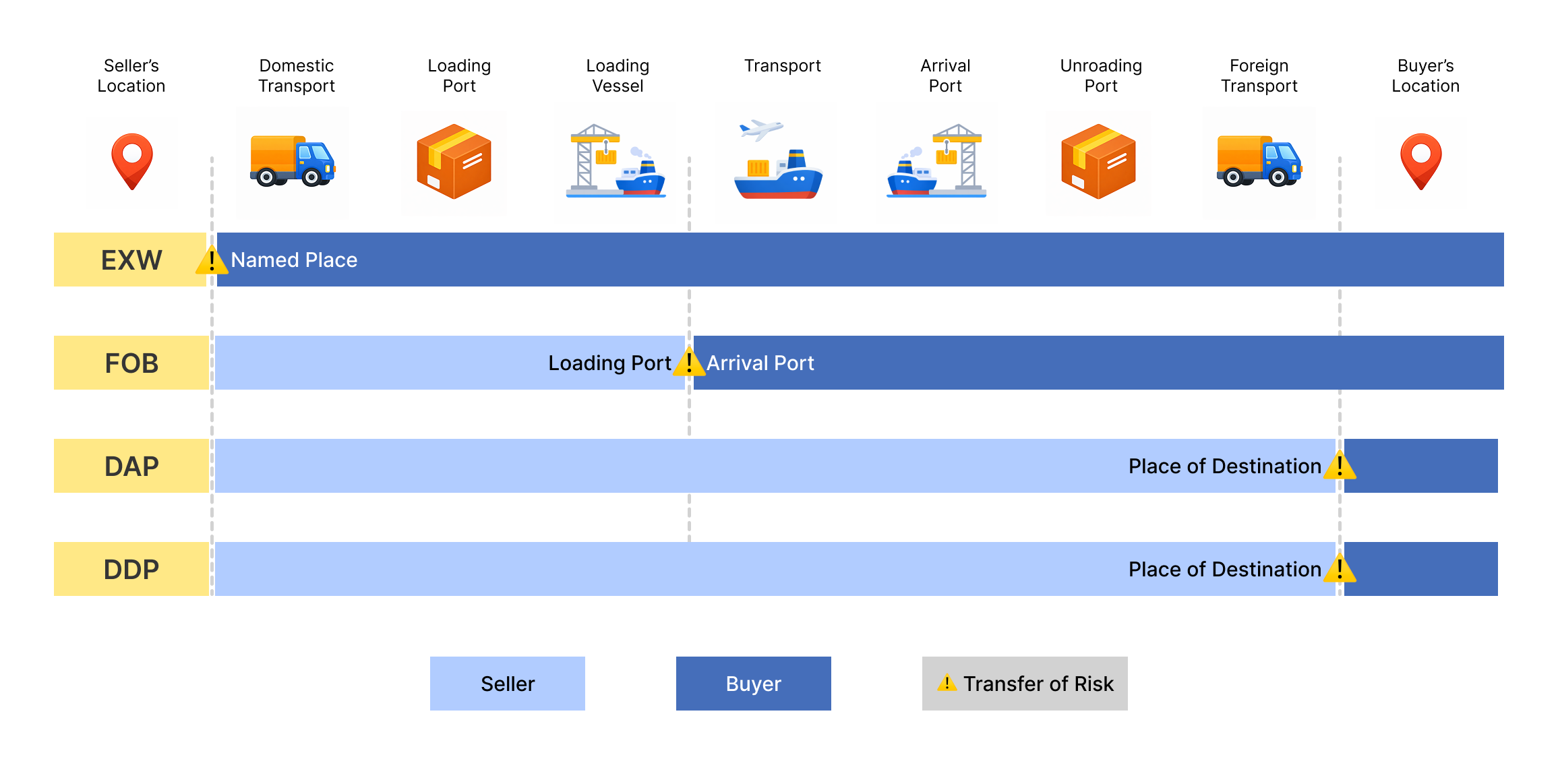
EXW (Ex Works)
Under EXW, the seller prepares the goods at the warehouse.
From pickup onward, the buyer is responsible for:
Domestic transportation
International freight
Import customs
Duties and taxes
Risk transfers when the goods are collected.
EXW offers the highest level of flexibility for the buyer, but also comes with a significant management burden.
FOB (Free On Board)
Under FOB, the seller:
Handles export clearance
Delivers goods to the port
Loads goods onto the vessel
Risk transfers after loading onto the vessel.
From that point, the buyer manages ocean freight and import procedures.
FOB can reduce export-side coordination compared to EXW.
FOB vs EXW Summary
Item | EXW | FOB |
|---|---|---|
Domestic Transportation | Buyer | Seller |
Risk Transfer | Warehouse pickup | Vessel loading (standard) |
Buyer Control | Full | Partial |
Operational Complexity | High | Medium |
In practice at SEOUL4PM, the cost gap between FOB and EXW is often limited to domestic transportation and handover handling within Korea.
Another key difference is risk timing.
Under EXW, risk transfers at warehouse pickup.
Under FOB, while Incoterms define risk transfer at vessel loading, SEOUL4PM operationally considers risk to begin when the buyer’s nominated forwarder takes custody of the cargo.
For most buyers, the decision is less about overall price differences and more about where operational responsibility begins.
DAP vs DDP: Cost Transparency vs Import Handling
Another frequent question is: What is the difference between DAP and DDP?
Both are commonly used in courier shipping.
DAP (Delivered At Place)
Under DAP:
Seller pays international freight
Buyer pays duties and taxes
Buyer manages clearance steps
Risk transfers upon arrival at destination.
If customs requests payment or additional information, the buyer handles it locally (directly or through a broker).
DDP (Delivered Duty Paid — Standard Definition)
Under standard DDP:
Seller pays freight
Seller handles import clearance
Seller pays duties and taxes
The buyer receives goods without paying duties at delivery.
DAP vs DDP Summary
Item | DAP | DDP |
|---|---|---|
Duties/Taxes Funding | Buyer | Seller |
Clearance Handling | Buyer | Seller |
Cost Visibility | Partial | Full |
Many buyers assume DDP always means the seller fully absorbs import duties and taxes.
In real-world wholesale shipping, the practical difference is often how duties and taxes are processed and when they are paid.
How DDP Works on SEOUL4PM
At SEOUL4PM, “DDP” commonly refers to a duty-prepaid shipping program.
Under this structure:
Duties and taxes are estimated in advance
The buyer prepays them to SEOUL4PM before dispatch
SEOUL4PM arranges duty/tax payment using the prepaid amount
This helps reduce delivery delays and unexpected charges at arrival
Customs authorities may still conduct standard reviews depending on local regulations.
In other words, the focus is not only who pays, but how duties and taxes are prepaid and coordinated:
Prepaid via SEOUL4PM + coordinated duty/tax handling (DDP program)
Paid locally + buyer-managed clearance steps (DAP)
What Your Landed Cost Includes
SEOUL4PM is a wholesale sourcing company for Korean skincare and other K-beauty products. It buys from Korean brands and verified vendors. SEOUL4PM can price a whole product list at once: upload a file or paste your list on the Get prices page.
Landed cost is what each unit costs once it reaches your store: the product price plus the costs of getting it there. If SEOUL4PM arranges your shipping (DAP or DDP), your landed cost has these parts:
Wholesale price: shown with the MSRP (retail price) after you log in. Your invoice price uses the exchange rate on the date you placed your order.
Shipping: based on the weight and volume of your items and the delivery destination. Your cart and checkout show an estimated shipping cost for products with registered weight data. For larger volumes, SEOUL4PM can also arrange sea freight.
Duties, taxes and fees: these depend on DAP or DDP, as explained above. DDP is available on request.
Payment fee: credit card payments currently carry a 3.3% fee. Bank transfers have no fee. US bank account (ACH) payments have a flat $5 fee.
Storage, only if items wait: if items stay in the warehouse after you pay the remaining balance, storage fees start 14 days after packing is complete. The fee is currently $30 per pallet per month, and large-volume buyers have separate terms.
If you use your own forwarder under EXW or FOB, you pay the forwarder for international shipping. Under FOB, you also pay SEOUL4PM for local charges: domestic transport and export loading in Korea.
To get a per-unit landed cost, add up these costs for an order and divide by the number of units. Then compare the result with the price you plan to sell at.
Final Thoughts
Understanding Incoterms DAP, Incoterms DDP, FOB, and EXW helps avoid preventable issues around shipping costs, customs steps, and risk transfer.
At SEOUL4PM, shipments are structured based on each buyer’s logistics setup so responsibilities are clear from the start.